Month by month · every number sourced
How to Plan a Wedding Timeline, From Engagement to Thank-You Notes
Here is how to plan a wedding timeline: work backward from your date in phases: budget, guest count and venue first (12+ months out), then photographer and the vendors who book up fast, then attire, stationery and details, and finally confirmations in the last month. The average couple is engaged for about 14 months 8, which gives each phase room; with less time you keep the same order and shorten each step.
By the editorial team · Updated 2026-11-23 · Every number linked to its source

Your wedding deadlines, by date
Enter your wedding date below and the timeline shows which planning phase you are in today, how many weeks are left, and the handful of tasks that matter most right now.
Booking windows: 123456789101112
Want it on paper? The free printable planner has the full version with every task.
Most wedding planning stress comes from doing things in the wrong order: falling for a dress before you know the budget, or touring venues before you know how many people are coming. Knowing how to plan a wedding timeline fixes that: a good wedding planning timeline puts each decision where it belongs, so the earlier choices make the later ones easier.
This guide walks through the plan phase by phase, explains why each task sits where it does, and shows how to adapt if you have 9, 6 or even 3 months. Couples spend about 7 hours a week on planning on average 8, so the goal here is to make those hours count.
How to plan a wedding timeline: the phases at a glance
Think of the year in five stretches rather than twelve separate months. Each stretch has a theme, and once you know the theme you can tell whether a task is early, on time or late.
| When | Theme | What gets decided |
|---|---|---|
| 12+ months | Foundations | Budget, guest count, date, venue |
| 10–8 months | Key vendors | Photographer, music, florist, attire, save-the-dates |
| 7–4 months | Details | Stationery, transport, rings, menu, day-of schedule |
| 3–1 months | Final form | Guest list, invitations, license, fittings, seating |
| Last weeks and after | Hand-off and wrap-up | Confirmations, rehearsal, thank-yous, name change |
The exact month for each vendor varies by source, and we cover that on the vendor booking timeline page. What does not vary is the order: the venue sets the date, and almost every other vendor asks for the date before they will quote.
12+ months out: budget, guest count, venue
Start with money and people, because they decide everything downstream. Agree on a total budget and who is contributing before you look at a single venue. In 2025 weddings, parents and family covered 52% of the total cost and couples covered 48% 8, so this is often a family conversation, not just a couple's one.
Next, draft a first guest list. The average 2025 wedding had 117 guests 8, while couples planning 2026 weddings told Zola they expect about 145 13. Your number matters more than either average: it decides the venue size and most of the catering bill. Our guest list guide covers how to cut it down if needed.
Then pick a season or two or three possible dates and book the venue. 89% of 2025 couples booked a venue, and 83% called it the most important vendor choice 8. Most guides put venue booking 12–18 months out 3. Right after the venue, book the photographer, since a popular photographer can only shoot one wedding a day.
Key tasks in this phase:
- Set the budget and contributions
- Draft the guest list and a target count
- Choose dates, then book the venue
- Decide on a planner or coordinator
- Book the photographer (and videographer if you want one)
10–8 months out: the vendors who shape the day
With a date locked, turn to the people who decide how the day looks and sounds: band or DJ, florist, officiant, and hair and makeup. These vendors take a limited number of weddings per weekend, so in peak season they fill early. Peak season is long: 76% of 2025 weddings took place between May and October 8.
This is also when to start dress shopping. The Knot suggests buying the dress 8–10 months out, because production and shipping can take up to five months or longer 6. Set up your wedding website and a hotel room block for out-of-town guests around the same time.
Save-the-dates go out in this window too. The Knot's etiquette guide says 6–8 months before a local wedding, and no later than 6 months 10; Zola suggests 7–10 months 14. Destination and holiday-weekend weddings need closer to a year. The details are on our save-the-dates timing page.
7–4 months out: details and the day-of plan
The middle stretch is where a wedding planning checklist gets long but each item is small. Order invitations, book transportation, choose suits or tuxedos, and book the rehearsal dinner location. The Knot's checklist puts formal invitation orders around 5 months out 5, which leaves time for printing and addressing.
Buy wedding rings around 6 months out; sizing and engraving generally take six to eight weeks 5. Do the menu tasting, then finalise menu, bar and cake design.
This is also the right time to draft a first wedding day timeline with your photographer or planner. You do not need exact minutes yet. You need to know whether you want a first look, roughly when the ceremony starts, and how much time portraits will take, because those choices decide when hair and makeup begins.
Free printable planner · 40 pages
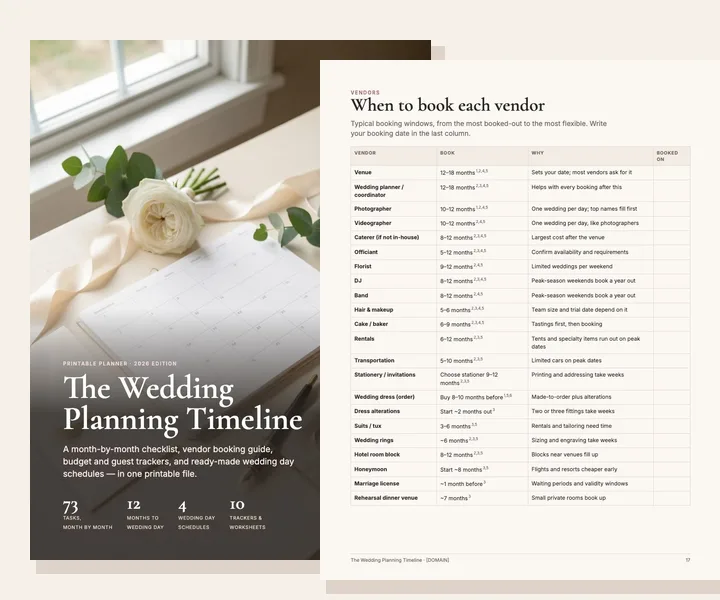
Get the complete wedding planning timeline
The printable planner turns this outline into a month-by-month checklist you can tick off, with 6- and 3-month versions if your date is closer.
- 73 tasks, month by month, with checkboxes
- When to book 21 vendors + comparison sheets
- Budget, guest list and RSVP trackers
- 4 wedding day schedules · US Letter and A4
3–1 months out: paperwork, invitations, final counts
Three months out, the guest list becomes final and addresses get cleaned up. Check the marriage license rules for your state or county now: waiting periods and validity windows differ, and The Knot notes licenses can be valid anywhere from 10 days to a year 5. Most couples apply about a month before.
Invitations usually go out 6–8 weeks before a local wedding 7, though other guides say 2–3 months; see when to send wedding invitations for how to choose. Set the RSVP deadline 2–3 weeks before the wedding 1 so you have time to chase missing replies.
In the final month, give the caterer the head count (often about a week out, but your contract sets the deadline) 5, make the seating chart, have the final fitting, and prepare tips and final payments in labelled envelopes.
The last weeks and after the wedding
Two weeks out, reconfirm every vendor and hand day-of jobs to specific people. The final week is for pickups, deliveries, the rehearsal and rest; our week of wedding checklist breaks it down day by day, and the emergency kit list covers what to pack.
After the wedding, send thank-you notes within about three months of receiving each gift 2, order certified copies of your marriage certificate, and, if you are changing your name, start with Social Security before other agencies 15. The name change checklist lists the order.
In what order should you plan a wedding?
If you remember only one rule, make it this: budget, then guest count, then date and venue, then everyone else. The Knot lists making plans before setting a budget and planning too much before choosing a venue among the most common planning mistakes 16.
After the venue, book in order of scarcity. Vendors who can work only one event a day and are in high demand come first (photographer, videographer, planner), then those with long production times (dress, custom stationery), then those with more flexibility (cake, rentals, transportation). Couples hired 13 vendors on average in 2025 8, so a clear order stops you from trying to book all of them at once.
Shorter timelines: 9, 6 or 3 months
A 12 month wedding timeline is comfortable, not required. About 40% of couples are engaged 11–18 months 8, which means plenty plan in less.
- 9 months: Keep the same order but book the venue and photographer in the first two to three weeks. Send save-the-dates promptly, since you are already near the 6–8 month window.
- 6 months: A 6 month wedding timeline works best with flexibility on date or venue. Skip save-the-dates if needed and send invitations a little earlier. Shop for ready-to-wear or in-stock attire, because made-to-order gowns may not arrive in time.
- 3 months: Choose a venue that bundles catering and rentals, keep the guest list small, and limit yourself to the vendors you truly need. Under 4 months, save-the-dates are too late 10; go straight to invitations.
We explain what fits in each window on how long to plan a wedding, and the small wedding checklist shows what to drop.
Budget questions that shape the timeline
Your budget decides how many vendors you can book and how early you need deposits ready. The average 2025 wedding cost $34,000, but the median was $24,000, and a quarter of couples spent $12,000 or less 8. Zola puts the 2026 average at $36,000 17.
Averages hide a lot, so a per-guest number is often more useful. The Knot's 2025 average was $292 per guest 8. By our arithmetic, that suggests roughly $29,000 for 100 guests at average spending, and about 17 guests for a $5,000 budget. Both are rough guides, not quotes: local prices and your choices move them a lot. 41% of 2025 couples went over budget 8, and The Knot names forgetting taxes, fees and tipping as a common reason 16. The wedding budget breakdown shows how the money usually divides.
Frequently asked questions
What is the typical timeline for planning a wedding?
Most couples plan for about a year or a little longer; The Knot's 2026 study puts the average engagement at 14 months. A typical timeline sets the budget, guest count and venue 12 or more months out, books key vendors 8–10 months out, handles stationery and details 4–7 months out, and spends the final month on invitations, counts, fittings and confirmations.
In what order do I plan my wedding?
Set the budget first, then draft the guest list, then choose a date and book the venue. After that, book vendors in order of scarcity: photographer and planner, then music, florist and officiant, then attire and stationery, and finally cake, rentals and transportation. This order works because the venue fixes the date and most vendors need the date before they quote.
What do couples most often forget on the wedding day?
Eating is the classic one: The Knot lists not eating all day among common mistakes. Others include checking the sunset time before setting the photo schedule, having a weather backup plan, bringing cash for tips, and keeping a list of vendor phone numbers. Hand the tips, list and an emergency kit to one trusted person so you do not have to think about them.
Who pays for the wedding?
There is no fixed rule today. In The Knot's study of 2025 weddings, parents and other family covered 52% of the total cost on average and couples covered 48%. Talk through contributions before you book anything, and agree on whether contributing family members also expect a say in decisions such as the guest list.
Is $5,000 a good budget for a wedding?
It can work for a small wedding, but it is well below typical spending: The Knot reports a 2025 median of $24,000, with a quarter of couples spending $12,000 or less. At the 2025 average of $292 per guest, $5,000 covers roughly 17 guests by our arithmetic. Lower costs come from a short guest list, a weekday or off-season date, and fewer vendors.
What is a realistic budget for a 100-person wedding?
Using The Knot's 2025 average of $292 per guest, 100 guests works out to about $29,000 by our arithmetic. That is a midpoint, not a price: your region, venue type and service style can move it a lot either way. Get two or three venue and catering quotes for your actual count before you commit to a total.
Sources
- Emily Post Institute: How to Word a Wedding Response Card
- Emily Post Institute: Wedding Thank Yous
- The Knot, 2023: When to Book Wedding Vendors to Secure Your Top Choices (updated Jul 25, 2023)
- The Knot, 2026: Wedding Budget Breakdown, Based on Real Couples' Data (updated Sep 29, 2026)
- The Knot, 2026: The Ultimate Wedding Planning Checklist, Plus a Timeline (updated Oct 27, 2026)
- The Knot, 2026: When to Buy Your Wedding Dress: Shopping Timeline & Tips (updated Sep 29, 2026; cites The Knot 2024 Attire & Fashion Study)
- The Knot, 2026: When to Send Wedding Invitations: A Definitive Timeline (updated Jul 14, 2026)
- The Knot, 2026: The Knot Real Weddings Study 2026 (Data Read-Out PDF; 10,474 US couples married in 2025)
- The Knot Worldwide, 2026: The Knot Worldwide Unveils 2026 Real Weddings Study (press release, Feb 18, 2026)
- The Knot, 2025: Save-the-Date Etiquette: When to Send Them (updated Apr 17, 2025)
- WeddingWire, 2018: Exactly When to Book Your Wedding Vendors (published Jul 22, 2018)
- Zola, 2024: Exactly How Far Out to Book Each Wedding Vendor (last updated Feb 5, 2024)
- Zola, 2026: 2026 Wedding Trends: Zola's First Look Report (11,500+ couples marrying in 2026)
- Zola, 2026: When Should You Send Out Your Wedding Invitations? (page date shows 2026)
- USAGov (U.S. General Services Administration), 2026: How to change your name after marriage or divorce
- The Knot, 2023: 60 Wedding Mistakes a Wedding Planning Editor Sees Most Often (updated Jul 21, 2023)
- Zola, 2026: Average Cost of Weddings in 2026 (Zola Wedding Cost Index; last updated Mar 6, 2026)