Wedding planning
Wedding Guest List Template: How to Build the List
By the editorial team · Updated 2026-11-23 · Every number linked to its source
Quick answer. A wedding guest list template should track each household with names, address, side, tier (A or B list), plus-one and kids status, and RSVP reply. Expect roughly 20% of invited guests to decline, but plan your venue and budget for the full list 1. The average 2025 wedding had 117 guests 2.
How many guests will come?
Add how many people each side and each tier would invite, and the estimator shows your total list and a rough range for how many are likely to say yes.
Rule of thumb: about 20% of invited guests decline1.
Want it on paper? The free printable planner has the full version with every task.
The guest list is the first real planning decision, and it quietly sets most of the others. Venue size, catering, rentals, invitations and even the number of tables follow the head count, which is why the list belongs right next to the budget at the start of planning.
A good wedding guest list template is less about a pretty spreadsheet and more about rules you agree on before anyone starts adding names. This page walks through how to build the list, the common rules couples use, and how to estimate who will actually come.
How to make a wedding guest list, step by step
Start with the number, not the names. Agree on your total budget and a target guest count together, because cost per guest is what turns a long list into a big bill. The Knot's 2026 study puts the average cost per guest at $292 for 2025 weddings 2. Even a rough figure like that helps you see what each extra table means.
Then build the list in rounds:
- Brainstorm everyone. Each partner, and each set of parents if they are contributing, writes a full list without filtering.
- Merge and remove duplicates. Group people by household.
- Sort into tiers. Must-invite people go on the A list; people you would love to include if space allows go on the B list.
- Compare to your target. If the A list alone is over the number, cut there first.
- Collect addresses for everyone on the final list, ideally months before invitations go out.
Our wedding planning timeline puts the first draft in the 12+ month phase and the final list and addresses about three months before the wedding.
What to put in a wedding guest list template
One row per household works better than one row per person. It matches how you address envelopes and how replies come back. Useful columns:
| Column | Why it matters |
|---|---|
| Household name and guest names | For envelopes and escort cards |
| Mailing address | For save-the-dates and invitations |
| Side (partner 1, partner 2, shared) | Helps balance the list |
| Tier (A or B) | Shows who gets invited if space opens up |
| Plus-one allowed | Avoids guesswork later |
| Number invited | Counts children and plus-ones |
| RSVP: yes / no / count | Your running head count |
| Meal choice or dietary needs | For the caterer |
| Gift received / thank-you sent | For thank-you notes |
Keep one master copy. If both partners and parents edit separate versions, someone will be invited twice or not at all.
Wedding guest list rules couples commonly use
Rules are what make cuts feel fair. None of these are official etiquette; they are common practices that couples choose between. Pick the ones that fit and apply them to both sides equally.
- The "haven't met" rule. If neither of you has met the person or spoken to them in a few years, they are a B-list candidate.
- Plus-ones by relationship. Many couples give plus-ones to guests who are married, engaged or living with a partner, and to members of the wedding party, but not to every single guest.
- Kids policy. Decide whether children are invited, only immediate family's children, or none. Address invitations to the people invited, so the envelope itself communicates the policy.
- Work colleagues. Invite all of a team or none of it, to avoid awkward conversations at the office.
- Parents' guests. If parents are contributing, agree up front how many spots they get.
Inviting too many guests is on The Knot's list of common wedding mistakes 3. Clear rules early make that much easier to avoid.
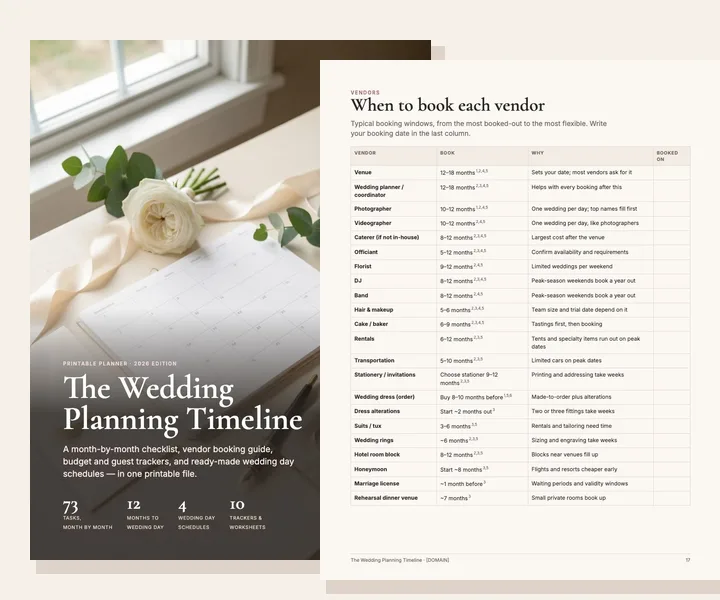
Free printable planner · 40 pages
Get the complete wedding planning timeline
The printable guest list and RSVP tracker gives every household a row for tier, plus-one, reply and meal choice, so both sides work from one copy.
- 73 tasks, month by month, with checkboxes
- When to book 21 vendors + comparison sheets
- Budget, guest list and RSVP trackers
- 4 wedding day schedules · US Letter and A4
How many people decline wedding invitations?
A rule of thumb many wedding professionals agree on is that about 20% of invited guests decline, so roughly 80% say yes 1. The studies The Knot cites range more widely, from 60% to 85% of guests accepting, and a small handful of people who say yes will drop out at the last minute.
The acceptance rate shifts with circumstances. Guests who would need to travel, weddings on holiday weekends, and lists heavy with distant acquaintances tend to see more declines; a small list of close family tends to see fewer. No authoritative figure exists for destination weddings specifically, so treat any number you see quoted for them with caution.
The important caveat: The Knot's advice is to plan your venue capacity and budget for the full invited list, not for the expected 80% 1. If everyone says yes, you still need a seat and a meal for each of them.
Average guest count and what it means for your list
The Knot reports an average of 117 guests at 2025 weddings, close to 116 the year before 2. Zola's First Look Report, which surveys couples before their weddings, shows a higher planned average of 145 guests for 2026 4. The gap likely reflects the difference between planned and actual weddings: lists tend to shrink as couples see costs.
Use the average only as a reference point. Your venue's capacity, your budget and your family size matter far more. If you are aiming much smaller, our small wedding checklist covers what changes.
Using an A list and B list without hurt feelings
Send the A list's invitations first, at the normal time. As declines come in, you can invite B-list guests, but only if there is still enough time for them to reply comfortably before your RSVP deadline. Sending B-list invitations within the last few weeks makes the order obvious.
Two things help. First, never send a save-the-date to anyone on the B list, because a save-the-date promises an invitation; our save-the-date timing page explains why. Second, print a slightly later reply date on any invitations you send in the second round, so both groups have similar time to respond.
Tracking RSVPs until the final count
Once invitations are out, the guest list becomes your RSVP tracker. Update it the day each reply arrives, and note meal choices and dietary needs in the same row. Emily Post suggests setting the reply deadline about two to three weeks before the wedding 5, which leaves time to call anyone who has not answered.
After the deadline, total the yes column and give that number to your caterer and venue. The Knot's checklist suggests confirming RSVPs about two weeks before and sending a final headcount around a week out 6, but follow the date in your contract. With the count settled, you can start on the wedding seating chart.
Frequently asked questions
How do you do a guest list for a wedding?
Agree on a budget and target guest count first. Then each partner, and contributing parents, list everyone they would invite. Merge the lists by household, remove duplicates, and sort names into an A list of must-invites and a B list of maybes. Cut from the A list until it fits your number, then collect addresses.
What is the rule of thumb for a wedding guest list?
Many wedding professionals plan on about 20% of invited guests declining, so around 80% accept, according to The Knot. Studies it cites range from 60% to 85% accepting. Even so, the safest rule is to choose a venue and budget that can handle everyone on your list saying yes.
How many guests does an average wedding have?
The Knot's 2026 Real Weddings Study reports an average of 117 guests for weddings held in 2025. Zola's survey of couples planning 2026 weddings shows a planned average of 145. Use these as reference points only; your venue size, budget and family will decide your number far more than any national average.
Is there a free template for a wedding guest list?
Any spreadsheet can work if it has one row per household and columns for names, address, side, A or B tier, plus-one status, number invited, RSVP reply, meal choice and thank-you notes. Our printable planner includes a guest list and RSVP tracker laid out this way, ready to fill in by hand.
Should every guest get a plus-one?
Not necessarily. A common approach is to give plus-ones to guests who are married, engaged or living with a partner, and to the wedding party, while single guests come alone. Whatever rule you choose, apply it the same way to both sides, and write exactly who is invited on the envelope so there is no confusion.
Sources
- The Knot, 2024: What Percentage of Wedding Guests RSVP Yes? (updated Feb 27, 2024)
- The Knot, 2026: The Knot Real Weddings Study 2026 (Data Read-Out PDF; 10,474 US couples married in 2025)
- The Knot, 2023: 60 Wedding Mistakes a Wedding Planning Editor Sees Most Often (updated Jul 21, 2023)
- Zola, 2026: 2026 Wedding Trends: Zola's First Look Report (11,500+ couples marrying in 2026)
- Emily Post Institute: How to Word a Wedding Response Card
- The Knot, 2026: The Ultimate Wedding Planning Checklist, Plus a Timeline (updated Oct 27, 2026)