Wedding planning
Wedding Budget Breakdown: Where the Money Actually Goes
By the editorial team · Updated 2026-11-23 · Every number linked to its source
Quick answer. A typical wedding budget breakdown puts about 29% toward the venue and rentals, 24% toward catering, cake and drinks, and 10% toward photo and video, with everything else sharing the rest 1. The average 2025 US wedding cost $34,000, but the median was $24,000, so half of couples spent less 2.
Split your budget
Enter your total budget below and the calculator splits it across categories using the same percentages, so you can see a realistic ceiling for each vendor before you start getting quotes.
Want it on paper? The free printable planner has the full version with every task.
A wedding budget breakdown is most useful before you sign anything. Once the venue contract is in, roughly a third of your money is committed, and every other line has to fit around it. The numbers on this page come from large surveys of real US couples, and they give you a starting split you can adjust to what you care about.
Treat the percentages as a sketch, not a rule. A couple who wants a packed dance floor will move money toward music; a couple marrying in a family backyard will move it away from the venue. What matters is that each category gets a number early, so you notice when one starts to crowd out another.
Wedding budget percentages by category
The Knot published this split, pulled directly from its couples' data 1. The rows add up to 101% because of rounding.
| Category | Share of budget |
|---|---|
| Venue and rentals | 29% |
| Catering, cake and drinks | 24% |
| Photographer and videographer | 10% |
| Floral design and decor | 9% |
| Music | 6% |
| Attire and beauty | 6% |
| Wedding rings | 5% |
| Wedding planner | 5% |
| Guest entertainment | 3% |
| Transportation | 2% |
| Stationery | 1% |
| Officiant | 1% |
Two lines, venue and food, take more than half the budget. That is why guest count matters so much: both scale with the number of people you feed and seat. The smaller lines are where couples tend to overspend in small steps, because each one looks minor on its own.
Average wedding cost vs. median cost
The Knot reports an average cost of $34,000 for 2025 weddings, up from $33,000 in 2024 2. Zola puts the average for 2026 weddings at $36,000 4. The two figures measure slightly different things: The Knot surveyed couples who already married, while Zola's report covers couples still planning.
The median is the more honest benchmark for most people. In The Knot's 2025 data the median was $24,000; a quarter of couples spent $12,000 or less, the middle half spent between $12,000 and $41,000, and a quarter spent more than $41,000 2. A small share of very expensive weddings pulls the average up, so if your number sits well below $34,000, you are in ordinary company.
Wedding cost per guest
The Knot puts the average cost per guest at $292 for 2025, up from $284 the year before 2. That figure is the clearest way to test a guest list against a budget. Multiply your draft head count by a per-guest number, and you see straight away whether the list and the budget agree.
For example, 100 guests at $292 each comes to $29,200 by our arithmetic. If your budget is $20,000, you can either shorten the list or plan a lower-cost format, such as a lunch reception or a buffet. Per-guest cost is an average across all spending, not only food, so it shrinks only partly when you cut a few names. Our guest list guide covers how to trim fairly.
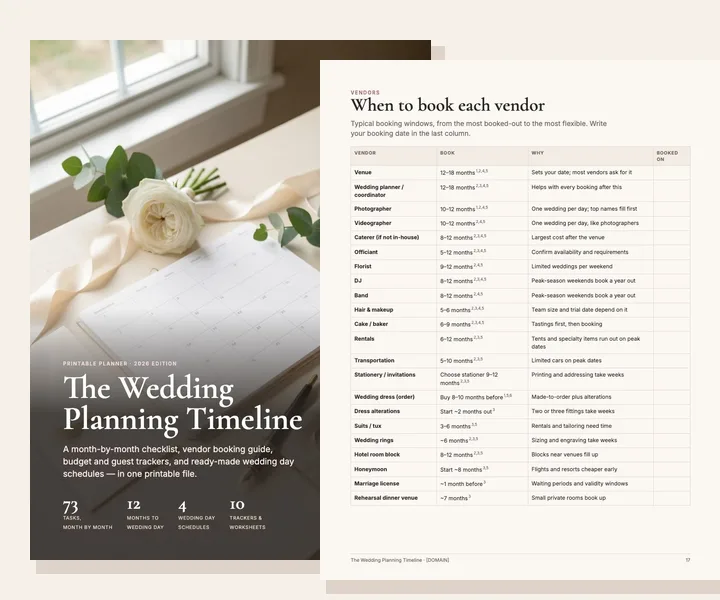
Free printable planner · 40 pages
Get the complete wedding planning timeline
The printable budget planner and payment schedule let you write each category's ceiling and due dates on one page, so you can see what is left before every new quote.
- 73 tasks, month by month, with checkboxes
- When to book 21 vendors + comparison sheets
- Budget, guest list and RSVP trackers
- 4 wedding day schedules · US Letter and A4
How to set your wedding budget
Start with the money, not the wish list. The Knot lists making plans before setting a budget as one of the most common planning mistakes 5. A simple order works for most couples:
- Agree on the total you and any contributors can cover without new debt.
- Ask contributors early what they plan to give, and whether it comes with expectations.
- Hold back a buffer for the costs that appear late, before you split the rest.
- Assign each category a ceiling using the percentages above as a draft.
- Rank your top three priorities and let them borrow from the bottom of the list.
On who contributes, there is no fixed pattern. In The Knot's 2025 data, parents and family covered 52% of the total cost on average and couples covered 48% 2. Every family splits it differently, and the useful step is to have the conversation in month one rather than month ten. That is also the first task in our planning timeline.
Costs couples forget to budget for
Quotes rarely include everything you will pay. The Knot names taxes, service fees and tipping as items couples often leave out 5. A venue quote may not include the service charge, and a catering quote may not include staff or cake cutting. Ask each vendor for an all-in figure before you compare.
Other easy misses are postage for invitations, alteration costs on top of the dress price, and wedding insurance, which The Knot also lists among skipped items 5. Put each of these in the budget as its own line so it cannot quietly come out of the buffer.
Wedding budget checklist: how to trim if you run over
Running over is common. Among 2025 couples, 41% went over budget, 34% stayed on track, 4% came in under, and 21% had no budget at all 2. If your quotes add up to more than you planned, cut in this order:
- Guest count first. It drives the two largest categories at once.
- Day and season next. Off-peak dates and times often give you more room to negotiate with venues.
- Format of the meal. In 2025, 60% of receptions served buffet or stations and 30% served plated meals 2, so a buffet is far from unusual.
- Small lines last. Favors, extra signage and upgrades add up, but cutting them rarely closes a large gap.
Avoid trimming the things that are hard to fix later, like photography if it matters to you. A cheaper dessert can be swapped; missing photos cannot.
What typical vendors cost
Category averages help you sanity-check a quote. In The Knot's 2025 data, couples spent on average $12,900 on the venue, $3,000 on a photographer, $2,800 on a florist, $2,000 on event rentals and $1,800 on a DJ 2. Zola's cost index gives higher figures for several categories, including $4,400 for photography and $8,573 for venue and site fees 6, but its category averages add up to more than its own total, so read them as rough sizes rather than shares.
If a quote lands far above these figures, ask what is included before you rule it out. Hours of coverage, number of staff and delivery fees explain most of the gap. When you are ready to book, the vendor booking timeline shows which contracts to sign first.
Frequently asked questions
What is a reasonable budget for a wedding?
A reasonable budget is one you can pay for without new debt, sized to your guest list. For context, the median US wedding in 2025 cost $24,000 and the average was $34,000, according to The Knot. A quarter of couples spent $12,000 or less. Start from what you and any contributors can actually give, then fit the guest count and venue to it rather than the other way around.
What does a wedding DJ cost?
In The Knot's 2025 survey, couples who hired a DJ spent $1,800 on average, and 71% of couples hired one. Music overall takes about 6% of a typical budget. Prices vary with hours, location, equipment and whether the DJ also handles ceremony sound, so compare quotes on the same hours and ask what is included before deciding.
Is $5,000 enough for a wedding?
Yes, if you design the day around it rather than shrinking a larger plan. That usually means a courthouse or backyard ceremony, a meal at a restaurant or at home, and a short list of close family and friends. Pick the one or two things that matter most, such as photos or a dinner together, pay for those first, and let everything else stay simple or borrowed.
Is $10,000 a small wedding budget?
Compared with national data, yes. In The Knot's 2025 survey a quarter of couples spent $12,000 or less, so $10,000 sits in the lower quarter. That still allows a lovely wedding, especially with a shorter guest list, a daytime reception or a venue that includes tables and chairs. Our small wedding checklist covers what you can simplify.
What percentage of a wedding budget goes to the venue?
In The Knot's data, venue and rentals take about 29% of the budget, the largest single share. Catering, cake and drinks follow at 24%. Together they account for more than half of spending, which is why guest count has such a large effect: both scale with the number of people you seat and feed. Get the venue quote early and build the rest around it.
Sources
- The Knot, 2026: Wedding Budget Breakdown, Based on Real Couples' Data (updated Sep 29, 2026)
- The Knot, 2026: The Knot Real Weddings Study 2026 (Data Read-Out PDF; 10,474 US couples married in 2025)
- The Knot Worldwide, 2026: The Knot Worldwide Unveils 2026 Real Weddings Study (press release, Feb 18, 2026)
- Zola, 2026: 2026 Wedding Trends: Zola's First Look Report (11,500+ couples marrying in 2026)
- The Knot, 2023: 60 Wedding Mistakes a Wedding Planning Editor Sees Most Often (updated Jul 21, 2023)
- Zola, 2026: Average Cost of Weddings in 2026 (Zola Wedding Cost Index; last updated Mar 6, 2026)