Wedding planning
When to Send Wedding Invitations
By the editorial team · Updated 2026-11-23 · Every number linked to its source
Quick answer. For a local wedding, mail invitations about 6–8 weeks before the date, leaning toward 8 weeks if guests reply by paper card 4. Some planners prefer 2–3 months 2, and for destination weddings add extra weeks. Set the RSVP deadline 2–3 weeks before the wedding 6.
When to mail everything
Enter your wedding date and whether guests are traveling, and the calculator works backward to your order date, mailing date and RSVP deadline.
Want it on paper? The free printable planner has the full version with every task.

Knowing when to send wedding invitations is really a question about two other dates: the RSVP deadline and the day your caterer needs a final count. Work backward from those, and the mailing date mostly picks itself. The common window is 6–8 weeks out for a local wedding 4, but the right answer for you depends on travel, how guests reply, and how much printing time you leave yourself.
This page covers the timing for local and destination weddings, how to pick an RSVP date, and the ordering and postage steps that have to happen before anything goes in the mail.
When to send wedding invitations for a local wedding
If you are deciding when to send out wedding invitations for a local wedding, The Knot's invitation guide puts the standard window at 6–8 weeks before the wedding, and suggests going closer to 8 weeks if you are using paper reply cards, since those take time to travel both ways 4. That gives guests enough notice to arrange the day, but not so much that the invitation gets buried on the fridge.
Not every source agrees. The Knot's own planning checklist suggests mailing 2–3 months ahead 2, and Zola's article mentions 6–8 weeks in its introduction but 3–4 months in the body text 3. In practice, all of these land in the same place: if guests already have a save-the-date, 8 weeks is comfortable for most local weddings. If you skipped save-the-dates, mailing earlier closes that gap.
A simple rule: the more of your guests who will need to book anything (a hotel, a babysitter, time off), the earlier in that range you should mail.
Destination wedding invitations need more lead time
Guests who fly or drive a long way need more than eight weeks to decide, and this is where advice splits further. The Knot's invitation guide still says about 8 weeks for destination weddings 4, while The Knot's checklist recommends 4–6 months 2. Zola simply advises adding a few weeks to the local timeline 3.
The way to reconcile them: the save-the-date carries the travel planning, and the invitation confirms the details. If your save-the-dates went out about a year ahead, an invitation 3 months out is usually plenty. If you are late on save-the-dates, push the invitation toward the 4–6 month end so guests are not pricing flights at the last minute.
Destination weddings are not rare. About 17% of couples married in 2025 had one 9, so many of your guests will have handled this kind of trip before. They still need your hotel block, travel dates and website link early.
Wedding RSVP deadline: when should RSVPs be due?
Emily Post's guidance is to set the reply date usually two to three weeks before the wedding, which leaves time to follow up with people who forget and to give vendors a final number 6. Zola suggests a full month before 3, which is worth considering if your venue or caterer asks for the count early.
The deadline should come from your contracts, not from a template. The Knot's checklist suggests confirming RSVPs around two weeks out and sending the final headcount to your caterer about a week before 2, but the real cutoff is whatever your catering agreement says. Read it first, then set the RSVP date a week or so before that cutoff so you have room to chase missing replies.
On the card or website, keep the line plain: "Kindly reply by September 19" or "Please respond by the nineteenth of September" both work. Our wedding invitation wording page has more examples of the reply line.
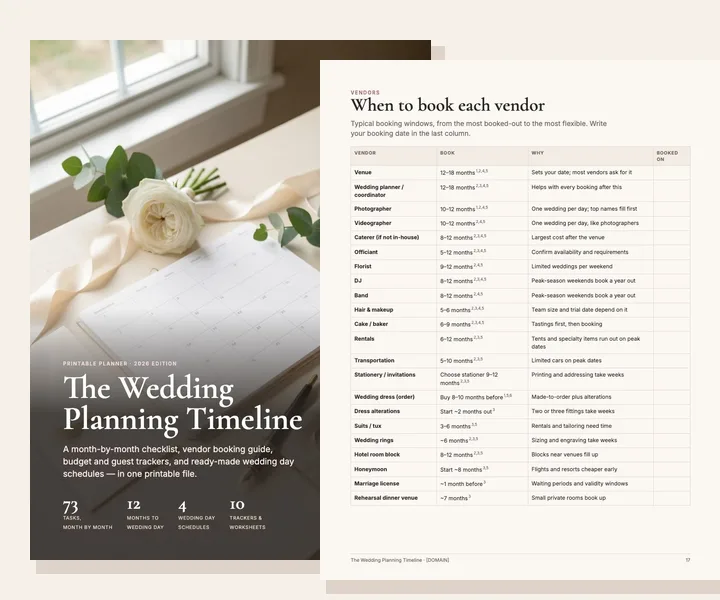
Free printable planner · 40 pages
Get the complete wedding planning timeline
The printable mailing dates worksheet turns your wedding date into every order, mail and RSVP deadline on one page you can stick on the fridge.
- 73 tasks, month by month, with checkboxes
- When to book 21 vendors + comparison sheets
- Budget, guest list and RSVP trackers
- 4 wedding day schedules · US Letter and A4
Order invitations months before you mail them
The mailing date is the end of a chain that starts much earlier. The Knot suggests choosing a stationer 9–12 months out 5 and ordering formal invitations around 5 months before the wedding 2. That sounds early, but proofs, printing, addressing and assembly all take time, and a single typo in the venue name means a reprint.
A realistic sequence for a local wedding looks like this:
| Step | Roughly when |
|---|---|
| Choose stationer | 9–12 months before 5 |
| Order invitations | about 5 months before 2 |
| Finalize guest addresses | about 3 months before |
| Mail invitations | 6–8 weeks before 4 |
| RSVP deadline | 2–3 weeks before 6 |
| Final count to caterer | about 1 week before, or per contract 2 |
Order a few more invitations than you have households. Late additions, mistakes in addressing and keepsake copies use up spares faster than most couples expect.
Postage: weigh one finished invitation first
Underpaying postage is on The Knot's list of the most common planning mistakes 10. Invitation suites are often heavier or thicker than a regular letter, and square envelopes, wax seals or ribbon can push them into a different price category. An invitation returned for postage costs you days you may not have.
Before you buy stamps, assemble one complete invitation with every insert, the reply envelope and any embellishment, and take it to the post office to be weighed. Buy postage for that exact package. Also put a stamp on each reply envelope if you use paper RSVPs, so replying costs your guests nothing.
Mail one invitation to yourself on the same day. It shows you how long delivery takes and what condition the envelope arrives in.
Is 3 months too early to send wedding invitations?
Not necessarily. Three months falls inside the 2–3 month window from The Knot's checklist 2 and close to Zola's longer range 3. It is a sensible choice for destination weddings, holiday weekends, or when you never sent save-the-dates.
The trade-off is that guests have more time to forget, and some will hold off replying until closer to the deadline anyway. If you mail early, use your wedding website for reminders and updates. About 90% of couples create one 9, and it is the easiest place to post hotel details or schedule changes without sending new mail.
Plan the replies before the invitations go out
Decide how you will track responses before the first envelope is mailed. Number the back of each reply card or keep a household list with a column for each reply, so an unsigned card can still be matched to a name. If you accept replies online as well, check both channels on the same day each week.
Expect some of your list to decline. A common rule of thumb among wedding professionals is that about 20% of invited guests say no 11, though you should still plan the venue and budget for the full list. Our wedding guest list page covers how to build that list, and the seating chart comes once the replies are in.
Frequently asked questions
How far in advance should wedding invitations be sent?
For a local wedding, about 6–8 weeks before the date is the standard window, with 8 weeks better if guests mail back paper reply cards. Some planners suggest 2–3 months, and destination weddings need more time, anywhere from a few extra weeks to 4–6 months depending on the source. Save-the-dates should already be out by then.
What is a reasonable RSVP deadline for a wedding?
Etiquette guidance from Emily Post suggests two to three weeks before the wedding. That leaves time to contact guests who forget to reply and to give your caterer and venue a final count. Check your catering contract first, because its headcount deadline is the real cutoff, and set the RSVP date about a week before it.
Is 3 months too early to send out wedding invites?
Three months is on the early side for a local wedding but fits The Knot checklist's 2–3 month range. It makes sense for destination weddings, holiday weekends or if you did not send save-the-dates. Guests may forget the date, so keep your wedding website updated and send a short reminder near the RSVP deadline.
How do you say RSVP by date on an invitation?
Keep it short and give a specific day: "Kindly reply by September 19" or "Please respond by the nineteenth of September." If replies are online, add the website address under that line. Avoid vague phrases like "as soon as possible", because a firm date is what makes guests actually reply before the caterer needs a count.
When should destination wedding invitations go out?
Sources differ. The Knot's invitation guide says about 8 weeks, while its planning checklist says 4–6 months, and Zola suggests adding a few weeks to the local timeline. If save-the-dates went out about a year ahead, around 3 months is usually enough. If they went out late, mail invitations closer to 4–6 months.
Sources
- The Knot, 2025: Save-the-Date Etiquette: When to Send Them (updated Apr 17, 2025)
- The Knot, 2026: The Ultimate Wedding Planning Checklist, Plus a Timeline (updated Oct 27, 2026)
- Zola, 2026: When Should You Send Out Your Wedding Invitations? (page date shows 2026)
- The Knot, 2026: When to Send Wedding Invitations: A Definitive Timeline (updated Jul 14, 2026)
- The Knot, 2023: When to Book Wedding Vendors to Secure Your Top Choices (updated Jul 25, 2023)
- Emily Post Institute: How to Word a Wedding Response Card
- Emily Post Institute: Wedding Thank Yous
- Emily Post Institute: Inviting Out-of-Towners to the Rehearsal Dinner
- The Knot, 2026: The Knot Real Weddings Study 2026 (Data Read-Out PDF; 10,474 US couples married in 2025)
- The Knot, 2023: 60 Wedding Mistakes a Wedding Planning Editor Sees Most Often (updated Jul 21, 2023)
- The Knot, 2024: What Percentage of Wedding Guests RSVP Yes? (updated Feb 27, 2024)