Wedding planning
Wedding Invitation Wording, Line by Line
By the editorial team · Updated 2026-11-23 · Every number linked to its source
Quick answer. Most wedding invitation wording follows the same order: who is hosting, a request line, the couple's names, the date and time, the venue and city, a reception line, and the reply details. Formal invitations spell out the date and time in words; casual ones use numerals. Ask guests to reply about 2–3 weeks before the wedding 2.
Invitation wording generator
Choose who is hosting and how formal you want to sound, add your names and details, and the generator lays out the invitation lines in the usual order for you to copy.
Traditional conventions: formal invitations spell out the date and time; “honour” is often reserved for ceremonies in a house of worship. Check with your stationer.
Want it on paper? The free printable planner has the full version with every task.
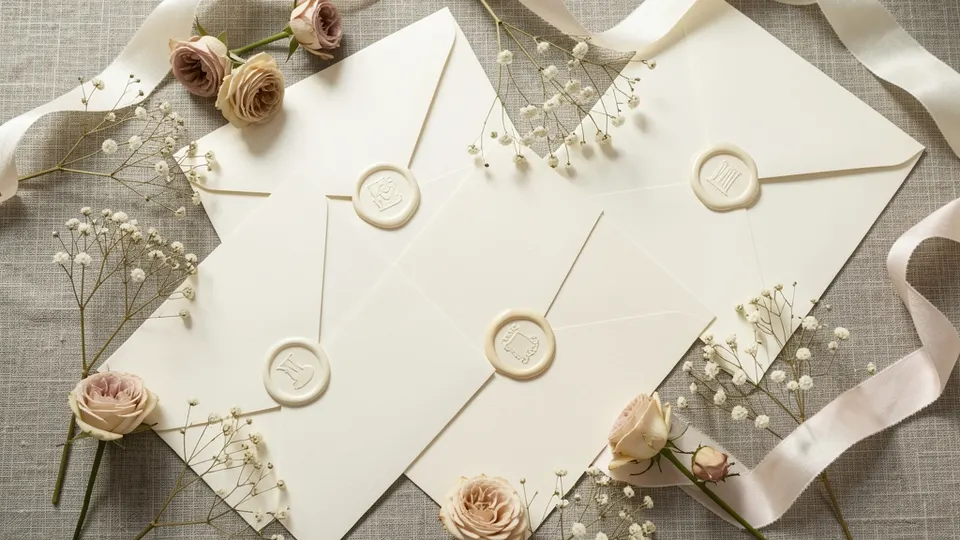
Good wedding invitation wording does two jobs. It tells guests exactly where to be and when, and it sets the tone of the event before they arrive. The structure is the same whether you write something traditional or relaxed; only the phrasing changes.
Below is the standard line order, then examples for the most common hosting situations, then the small conventions (dates, times, names) that trip people up. The names used are placeholders. Swap in your own, and read the result out loud before you send it to the printer.
The standard order of an invitation
Almost every invitation, formal or casual, uses these lines from top to bottom:
- Host line. Who is issuing the invitation: the couple, one or both sets of parents, or "together with their families."
- Request line. The ask, such as "request the pleasure of your company."
- Names. The couple, often joined by "and" or "to."
- Date and time. Day of the week, date, year and time.
- Location. Venue name, then city and state. Street addresses usually go on a details card or the website.
- Reception line. "Reception to follow" or "Dinner and dancing to follow."
- Reply line. On a separate card or at the bottom: the reply date and how to respond.
Keeping this order makes the card easy to scan. Guests look for the date, time and place first, and the layout should put them where people expect them.
Formal wedding invitation wording
Formal wording writes out the date, the year and the time in words, and avoids abbreviations. By common convention, "the honour of your presence" is used for ceremonies in a house of worship and "the pleasure of your company" for other venues. Many couples follow that distinction; others use whichever sounds right.
An example with the couple hosting:
Jordan Lee and Taylor Smith
request the pleasure of your company
at their marriage
Saturday, the tenth of October
two thousand twenty-six
at four o'clock in the afternoon
Riverside Hall
Portland, Oregon
Dinner and dancing to follow
Note that "four o'clock in the afternoon" replaces "4:00 p.m." and the state is written in full. Formal cards also skip "p.m." entirely, since the phrase "in the afternoon" or "in the evening" does that work.
Wedding invitation wording when parents are hosting
Traditionally, the host line names whoever is paying for the wedding. That is less clear-cut today: in The Knot's 2026 study, parents and family covered 52% of the total cost on average and couples covered 48% 1. Many invitations now credit everyone who contributes, or use a neutral host line.
When one set of parents is hosting:
Morgan and Casey Lee
request the pleasure of your company
at the marriage of their child
Jordan Lee
to
Taylor Smith
Traditional versions say "their daughter" or "their son" in that line. When the parents host, the couple member from that family is usually listed by first and middle name only, and the other partner by full name.
When both families host:
Morgan and Casey Lee
and
Avery and Riley Smith
request the pleasure of your company
at the marriage of their children
Jordan and Taylor
Divorced or remarried parents are each listed on their own line, which keeps the card readable and avoids implying a couple that no longer exists.
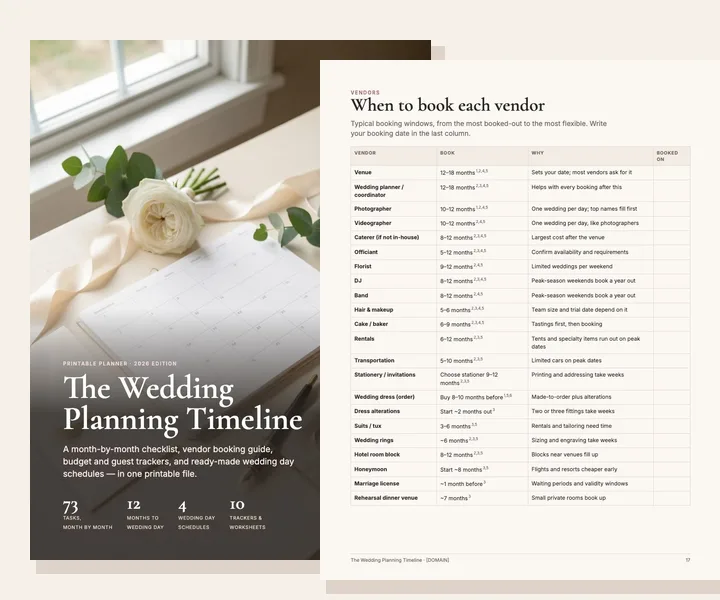
Free printable planner · 40 pages
Get the complete wedding planning timeline
The printable planner's mailing dates worksheet tells you when to order, proof and mail the suite once your wording is final.
- 73 tasks, month by month, with checkboxes
- When to book 21 vendors + comparison sheets
- Budget, guest list and RSVP trackers
- 4 wedding day schedules · US Letter and A4
Together with their families: the neutral option
If several people are contributing, or you simply do not want to rank anyone, open with the couple and mention the families as a group:
Together with their families
Jordan Lee and Taylor Smith
invite you to celebrate their marriage
This wording is common because it solves several problems at once: it acknowledges parents without listing names, works for blended families, and fits both formal and relaxed designs. It is a safe default if conversations about whose names go on the card are getting tense.
Casual wedding invitation wording
Casual invitations keep the same order but use everyday language and numerals. They suit backyard weddings, restaurant receptions and anything where the dress code is relaxed.
Jordan and Taylor are getting married
Join us on Saturday, October 10, 2026, at 4 p.m.
Riverside Hall, Portland, Oregon
Food, drinks and dancing after
Other openers that work: "Please join us as we tie the knot," "We're getting married and we'd love you there," or "Come celebrate with us." Keep any humor short. The card still needs to be clear for older guests who may only skim it.
Dates, times, names and the reply line
A few conventions make formal wording look finished:
- Dates: "Saturday, the tenth of October" with the year written as "two thousand twenty-six."
- Times: formal cards say "half past four o'clock" rather than "four-thirty"; casual cards simply say "4:30 p.m."
- Name order: there is no fixed rule for which partner is listed first. Couples often choose alphabetical order, the order that sounds best, or put the partner whose parents are hosting first.
- Reception: if the reception is at a different place, give its venue on a separate card or line.
For the reply card, Emily Post suggests a reply date usually two to three weeks before the wedding 2. A simple version: "Kindly reply by the nineteenth of September," followed by blank lines for names and "accepts" or "declines." If replies are online, print the web address there instead. Our page on when to send wedding invitations explains how to pick that date.
Proof before you print
Typos on invitations are expensive because the whole suite usually has to be reprinted. The Knot's checklist suggests ordering invitations about 5 months before the wedding 3, which leaves time for at least two rounds of proofs.
Have someone who is not involved in the planning read the proof for names, the day of the week matching the date, the venue spelling, and the reply date. Then weigh one finished suite before buying stamps, because underpaid postage is one of the most common planning mistakes 4.
Frequently asked questions
Whose name goes first on a wedding invitation?
There is no single fixed rule today. When parents host, the partner from that family is traditionally listed first, by first and middle name. When the couple hosts, many choose alphabetical order or whichever sounds best read aloud. Pick one order and use it the same way on the invitation, website, programs and signs.
What should be listed on a wedding invitation?
The host line, a request line, both partners' names, the day, date and time, the venue name with city and state, a reception line, and how and when to reply. Street addresses, directions, hotel details and dress code usually go on a separate details card or on your wedding website, which keeps the main card uncluttered.
How much do wedding invitations cost?
Zola's Wedding Cost Index lists about $500 as the average spend on an invitation suite 5, and The Knot's budget breakdown puts stationery at around 1% of a total wedding budget 6. Your cost depends on guest count, paper, printing method and inserts. Postage is extra, so weigh one finished invitation before budgeting for stamps.
What is the difference between formal and casual invitation wording?
Formal wording spells out the date, year and time in words, avoids abbreviations, and uses phrases like "request the pleasure of your company." Casual wording keeps the same order but uses numerals and everyday language, such as "Join us on Saturday, October 10, at 4 p.m." Match the wording to the dress code and venue.
How do you word an invitation when both families are hosting?
List both sets of parents at the top, each on their own line joined by "and," followed by "request the pleasure of your company at the marriage of their children" and the couple's first names. If many relatives are contributing, "Together with their families" followed by the couple's full names is a simpler, widely used alternative.
Sources
- The Knot, 2026: The Knot Real Weddings Study 2026 (Data Read-Out PDF; 10,474 US couples married in 2025)
- Emily Post Institute: How to Word a Wedding Response Card
- The Knot, 2026: The Ultimate Wedding Planning Checklist, Plus a Timeline (updated Oct 27, 2026)
- The Knot, 2023: 60 Wedding Mistakes a Wedding Planning Editor Sees Most Often (updated Jul 21, 2023)
- Zola, 2026: Average Cost of Weddings in 2026 (Zola Wedding Cost Index; last updated Mar 6, 2026)
- The Knot, 2026: Wedding Budget Breakdown, Based on Real Couples' Data (updated Sep 29, 2026)